Render Coin: Revolutionizing GPU Rendering with Blockchain Tech
Blockchain projects tend to promise a great deal, but only a few are built around a workload that already exists at industrial scale. Render Coin, the RENDER token that powers the Render Network, belongs to that smaller group. The Render Network bills itself as “the world’s first decentralized GPU rendering platform”: a marketplace that connects people who own powerful graphics cards with artists, studios, and developers who need serious computing muscle to turn digital scenes into finished images. GPU owners earn tokens for sharing hardware that would otherwise sit idle, while creators gain access to rendering capacity without buying expensive equipment of their own. This guide explains how the network operates, what the token actually does, where the market currently values it, and the risks worth weighing before you get involved.
Key Takeaways
- Decentralized rendering marketplace: The Render Network matches GPU owners with digital content creators, turning idle graphics hardware into a shared computational resource that anyone on the network can tap.
- Established history: Render Token was launched in 2017 by Jules Urbach, the founder of OTOY.
- Utility-driven token: RNDR is the utility token of the Render Network, used to pay for rendering work and to reward the GPU providers who complete it.
- Live market data: In early September 2026, major trackers quoted RENDER between $1.46 and $1.48, with CoinMarketCap reporting a market cap of $763.21 million.
- Broad applications: The platform supports rendering for 3D animation, visual effects, machine learning graphics, scientific visualization, and game development.
What Is Render Token (RENDER)?
Render Token is the cryptocurrency at the center of a blockchain platform that connects GPU owners with digital content creators who need computational power for rendering tasks. Rendering, converting a digital model, scene, or effect into a finished frame, is among the most demanding jobs a computer can perform. A complex animation or visual-effects sequence can tie up graphics hardware for long stretches, which is why studios have traditionally relied on large, centralized render farms or costly in-house machines.
The Render Network takes a different approach. Instead of concentrating hardware in a single data center, it distributes rendering jobs across a global pool of independent GPU owners. Idle graphics cards become a service: providers make their hardware available, creators submit jobs, and the RENDER token settles the exchange between the sides.
Origins and Background
Render Token was launched in 2017 by Jules Urbach, the founder of OTOY. The project emerged from Urbach’s vision of solving high-performance computing challenges in digital content creation. The core insight was simple: an enormous amount of GPU capacity sits unused around the world at any given moment, while creators simultaneously struggle to afford the rendering power their projects demand. A blockchain-based marketplace could put those groups in direct contact, with token payments and cryptographic verification replacing the middlemen of traditional cloud rendering.
Core Technology and Purpose
The network operates on a peer-to-peer distributed computing model that matches GPU providers with users requiring rendering services. Its proof-of-render mechanism sits at the heart of the system: GPU owners receive RNDR tokens as compensation for processing graphics tasks, and the work is validated before payment is released. Key technological features include:
- Secure blockchain transactions
- Decentralized allocation of computational resources
- Smart contract-based service agreements
- Transparent pricing and performance tracking
The platform supports rendering applications across a wide range of industries, including 3D animation, visual effects, machine learning graphics processing, scientific visualization, and game development. For creators, the appeal is access to scalable computing power without investing in expensive hardware. For GPU providers, it is a way to monetize idle graphics processing units while contributing to a global computational ecosystem.
How the Render Network Functions
Blockchain Infrastructure
The Render Network was built on Ethereum, where smart contracts automate transactions between GPU providers and users requesting rendering services, Coinbase, for example, lists RNDR as an ERC-20 asset. The blockchain layer provides transparent transaction tracking, cryptographic security, and the token-based economic incentives that keep providers participating. The proof-of-render consensus mechanism validates that submitted computational tasks were genuinely completed, which protects clients from paying for unfinished or faulty work and ensures fair compensation for resource contributors.
The GPU Rendering Marketplace
The marketplace itself connects individuals and organizations that own idle graphics processing units with users who need high-performance computational resources. Providers list available hardware; clients submit rendering jobs; and the network handles matching, allocation, and settlement. Its main features include:
- Peer-to-peer resource exchange without a central rendering vendor
- Competitive, demand-driven pricing mechanisms
- Dynamic matching of jobs to available computational resources
- Real-time task allocation
- Transparent performance metrics for both sides of the trade
The result is a marketplace that maximizes GPU utilization: hardware that would otherwise depreciate in silence earns income, and rendering work that would otherwise queue for scarce centralized capacity gets distributed across many machines at once.
Market Snapshot: RENDER by the Numbers
Cryptocurrency prices move constantly, and each data provider takes its own snapshot at its own moment, so it pays to compare several sources rather than trust a single figure. In early September 2026, the major trackers reported the following:
| Metric | CoinMarketCap | CoinGecko | Bybit |
|---|---|---|---|
| Price | $1.47 | $1.46 | $1.48 |
| Market cap | $763.21 million | $759,766,824 | $770.04 million |
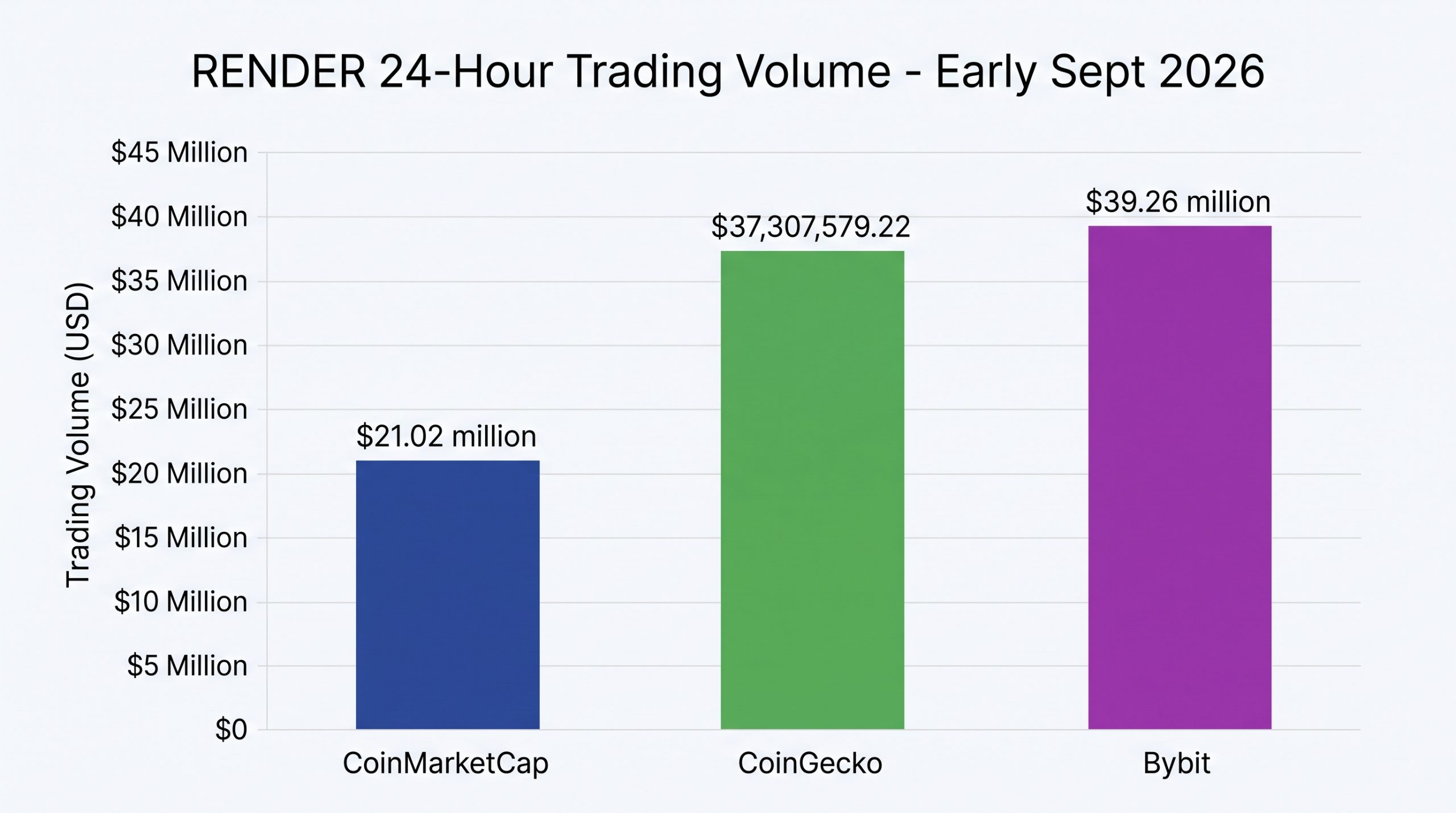
| 24-hour volume | $21.02 million | $37,307,579.22 | $39.26 million |
| Supply | 533.53 million (total) | 520 million (circulating) | 518.77 million (circulating) |
Bybit adds further detail: a maximum supply of 644.25 million tokens, a market-cap rank of #86, and a 24-hour trading range between $1.45 and $1.50. CoinMarketCap counted 217.32K holders. The small differences between providers are normal, each aggregator samples exchanges at a different instant, so treat any single number as an approximation rather than a precise valuation.
For the longer-term picture, Coinbase’s Render (ERC-20) page records an all-time high of $13.61, reached on March 17, 2024. Measured against the early September 2026 quotes above, the token trades far below that peak, a useful reminder of how wide this asset’s historical range has been.
Token Economics
RNDR is the utility token of the Render Network, a provider of decentralized GPU based rendering solutions. Rather than serving a purely speculative role, its design ties value to actual usage of the platform through several core mechanisms:
- Transaction incentives: providers earn tokens for contributing GPU computational resources.
- Computational pricing: the cost of a job reflects rendering complexity and network demand.
- Market liquidity: exchange listings let providers convert earned tokens and let clients acquire them for rendering work.
On the supply side, CoinMarketCap reports a total supply of 533.53 million RENDER, while Bybit lists a circulating supply of 518.77 million against a maximum supply of 644.25 million. A capped maximum supply limits long-run dilution, though, as with any token, demand for the underlying service ultimately determines what that scarcity is worth.
Price History and the All-Time High
RNDR’s defining price milestone is its all-time high of $13.61, set on March 17, 2024. Since then the token has traded through a wide range, and in early September 2026 it changes hands around $1.47. Historically, price movements have tracked platform technological upgrades, demand for GPU rendering, broader blockchain market sentiment, and strategic network partnerships, the same forces likely to shape its future path.
Investment Potential
Render Coin’s investment case rests on the intersection of an expanding market for digital content creation and increasing demand for decentralized computing. Every new animated production, game world, and machine-learning graphics workload adds to the pool of rendering demand the network can serve, while blockchain adoption across industries widens the audience comfortable transacting in tokens.
Factors that could influence future value include:
- Continued development of the network’s infrastructure
- Deeper integration between blockchain systems and graphics processing
- Expansion of marketplaces for computational resources
- Potential enterprise-level adoption of decentralized rendering
None of this guarantees returns. RENDER exhibits the volatility typical of cryptocurrency markets, and its valuation moves with technological developments, platform adoption, and industry-wide sentiment. Anyone considering a position should assess the network’s technological capabilities, its market positioning, and its long-term development strategy, and only commit funds they can afford to lose.
How Render Compares With Centralized Rendering
Traditional rendering options force creators to choose between buying expensive hardware outright or renting capacity from centralized cloud services. The Render Network’s decentralized model changes that calculus in several ways:
- Architecture: direct peer-to-peer GPU resource exchange removes the limitations of a single provider’s infrastructure and lets GPU owners anywhere in the world monetize their hardware.
- Pricing: dynamic, demand-based pricing with transparent blockchain-recorded transactions replaces opaque rate cards.
- Accessibility: the open marketplace has low entry barriers for providers and flexible participation models for different levels of hardware and expertise.
- Integrity: the proof-of-render consensus mechanism verifies computational work before payment, aligning incentives on both sides.
- Incentives: providers receive direct token rewards with transparent compensation mechanics and immediate liquidity through the RNDR token ecosystem.
In short, the platform bridges a real resource gap: it gives individual GPU owners a route to income and gives content creators an alternative to centralized rendering bottlenecks.
Risks and Challenges
Market Volatility
RENDER’s history illustrates how sharply crypto valuations can swing. A token that once traded at $13.61 was quoted near $1.47 in early September 2026. Even within the same snapshot period, reported activity varies by venue: 24-hour volume figures ranged from $21.02 million on CoinMarketCap to $39.26 million on Bybit. Market sentiment, technological developments, and broader blockchain trends all feed directly into the price, so investors should expect significant swings in both directions.
Technological Limitations
The network’s engineering challenges are ongoing rather than solved. GPU resource allocation algorithms require continuous optimization to distribute tasks efficiently, and several potential bottlenecks deserve attention:
- Computational synchronization delays across distributed hardware
- Network scalability constraints as job volume grows
- Smart contract execution reliability
- Performance verification mechanisms for completed work
- Bandwidth and latency issues during complex rendering tasks
Regulatory Considerations
Cryptocurrency regulation remains unsettled, and the rules vary significantly across jurisdictions. Key uncertainties include potential trading restrictions, compliance requirements in different countries, the question of whether tokens like RNDR could face securities classification, and the tax treatment of income earned from GPU rendering. Anyone participating in the network, as an investor or as a provider, should monitor the evolving legal landscape in their own jurisdiction.
Final Thoughts
Render Coin sits at a genuine intersection of blockchain technology and digital rendering. Its marketplace model gives idle GPUs productive work, gives creators affordable access to computational power, and ties the RENDER token’s role to a service people demonstrably use. The market data tells a sober story alongside the promising one: a project with real infrastructure and an active token economy, but also an asset trading far below its historical peak in a volatile, still-maturing sector. Understanding both sides of that picture, the technology’s capabilities and the market’s risks, is the foundation for any decision about participating in the network or holding its token.
Frequently Asked Questions
What is the Render Network?
The Render Network is a decentralized blockchain platform that connects GPU owners with creators who need computational power for graphics processing. The project describes itself as “the world’s first decentralized GPU rendering platform.” GPU owners rent out unused hardware and earn RNDR tokens, while creators obtain cost-effective rendering for work such as 3D animation, visual effects, and game development.
Who founded the Render Network?
Render Token was launched in 2017 by Jules Urbach, the founder of OTOY. The platform was built to address high-performance computing challenges in digital content creation by letting individuals and organizations monetize unused GPU resources.
What is the RENDER price right now?
Prices change by the minute, so always check a live tracker before acting. As a reference point, in early September 2026 CoinMarketCap quoted $1.47, CoinGecko quoted $1.46, and Bybit quoted $1.48.
What is RNDR’s all-time high?
According to Coinbase, RNDR reached an all-time high of $13.61 on March 17, 2024.
How can users earn RNDR tokens?
Users earn RNDR by contributing unused GPU resources to the network and completing rendering tasks. The proof-of-render mechanism rewards providers based on their computational contributions and verified task completion.
What industries benefit from the Render Network?
The platform supports 3D animation, visual effects, machine learning graphics processing, scientific visualization, and game development, any field where turning digital scenes into finished imagery demands more GPU power than a single workstation provides.
Is RENDER a good investment?
That depends on your risk tolerance and your view of decentralized computing. The token has genuine utility and an established history, but it is also volatile: it trades far below its $13.61 all-time high, and its value depends on platform adoption, technological progress, and regulatory developments. Evaluate the risks outlined above and never invest more than you can afford to lose.