Roulette Payouts Decoded: Boost Your Casino Winnings Now

Understanding roulette payouts can transform your casino experience from guesswork to strategic gameplay. Every wager on the layout, from a single chip placed squarely on one number to a broad even-money bet covering nearly half the wheel, carries its own payout ratio and its own probability of success. Once you know exactly what each bet pays and how often it can be expected to win, you can stop relying on hunches and start making decisions grounded in the mathematics of the wheel.
Roulette’s diverse betting options come with payout rates that can dramatically change your potential returns. Straightforward single-number bets deliver the biggest wins but land rarely, while outside wagers hit far more often in exchange for smaller rewards. Knowing these payout rates isn’t just about luck—it’s about making informed decisions that could maximize your potential returns and protect your bankroll along the way.
This guide breaks down every major roulette bet, what it pays, and how often it wins on both European and American wheels. It then explains how the house edge shapes your long-term results, and how sensible bet selection and disciplined bankroll management keep the game enjoyable and sustainable.
Key Takeaways
- 🎲 Roulette payouts vary significantly by bet type: higher-risk bets like straight-up numbers offer 35:1 payouts, while lower-risk outside bets provide more consistent 1:1 or 2:1 returns.
- 📊 European roulette offers more favorable odds with a 2.7% house edge compared to American roulette’s 5.26% house edge, making wheel selection an important decision.
- 💰 A balanced roulette approach combines inside and outside bets to spread risk and potential returns across different number groups.
- 🧮 Probabilities and payouts move in opposite directions: a straight-up bet wins only 2.7% of the time on a European wheel but pays 35:1, while even-money bets win far more often for a 1:1 return.
- 💡 Effective bankroll management—strict limits, outcome tracking, and keeping individual bets to 1-2% of total available funds—matters as much as bet selection.
Understanding Roulette Payouts
Roulette payouts determine your potential winnings based on the type of bet you place. Each betting option comes with specific odds and return rates that directly affect how quickly your bankroll can grow or shrink, and therefore how you should shape your overall strategy at the table.
Basic Payout Structures
The payout schedule is remarkably consistent across casinos. In the roulette guide published by MGM Resorts, split bets pay 17:1, street bets pay 11:1, corner bets pay 8:1, six line bets pay 5:1, dozen and column bets pay 2:1, and the even-money wagers—red/black, odd/even, and high/low—pay 1:1. At the top of the scale sits the straight-up bet on a single number, which Hard Rock Bet confirms pays 35 to 1: you win $35 for every $1 you bet, and you keep your original stake as well.
Types of Roulette Bets
Roulette betting options fall into two broad families. Inside bets are placed on the numbered grid itself: single numbers, pairs of adjacent numbers, rows, and small clusters. They are higher-risk wagers with larger potential payouts. Outside bets sit around the edge of the layout and cover large groups of numbers at once: colors, even or odd, high or low ranges, and dozens or columns. They are lower-risk wagers with more consistent, smaller returns. Each bet type presents its own mathematical probability, and understanding those probabilities is what separates informed play from pure guesswork.
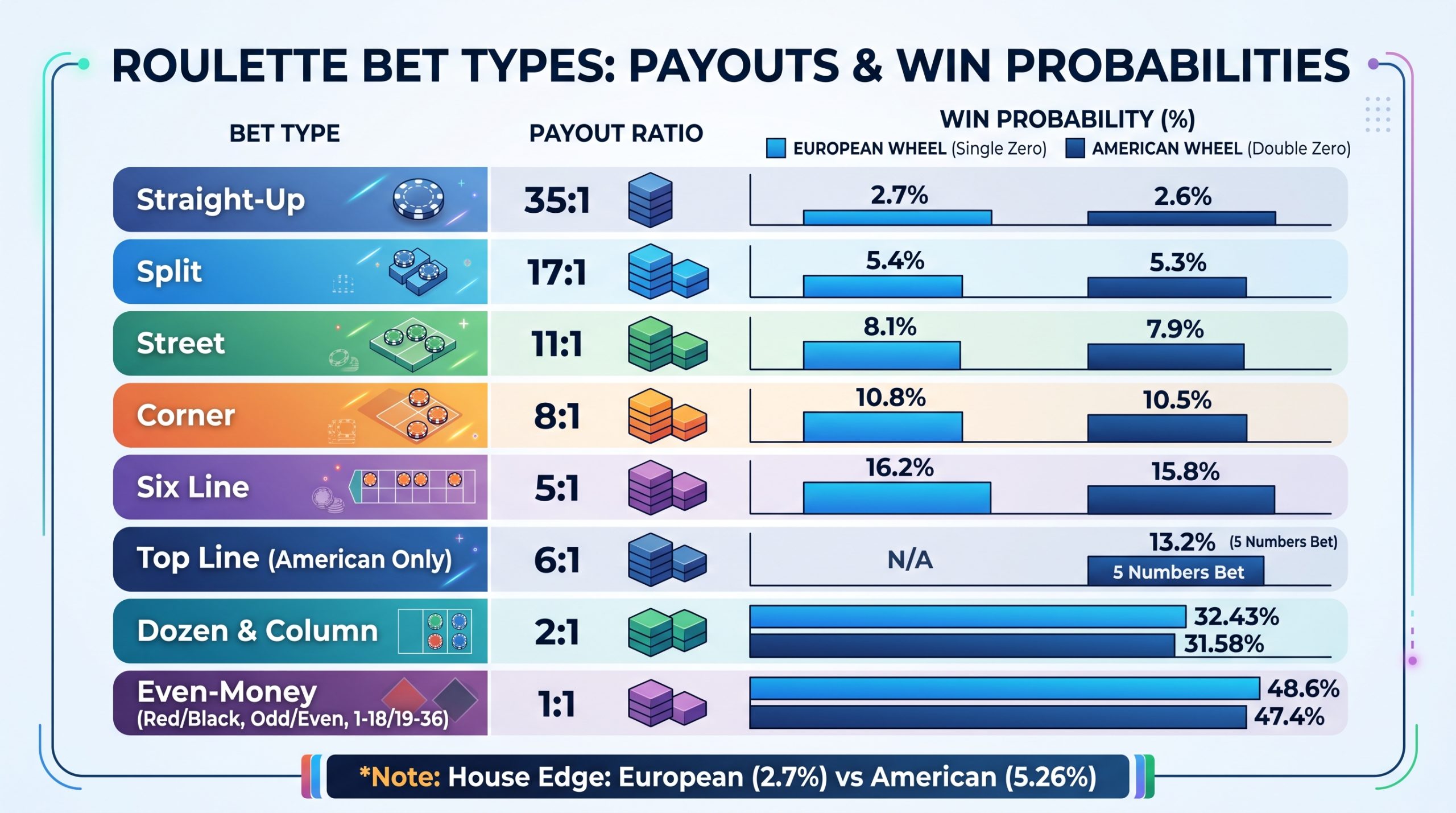
Roulette Payouts at a Glance
The table below combines the payout schedule listed by MGM Resorts with the win-probability tables published by PlayUSA, Vegas Aces, and Metropolitan Casinos.
| Bet type | Payout | Win probability (European) | Win probability (American) |
|---|---|---|---|
| Straight-up | 35:1 | 2.7% | 2.6% |
| Split | 17:1 | 5.4% | 5.3% |
| Street | 11:1 | 8.1% | 7.9% |
| Corner | 8:1 | 10.8% | 10.5% |
| Six line (double street) | 5:1 | 16.2% | 15.8% |
| Top line (American only) | 6:1 | n/a | 13.2% |
| Dozen | 2:1 | 32.43% | 31.58% |
| Column | 2:1 | 32.43% | 31.58% |
| Even-money (red/black, odd/even, high/low) | 1:1 | 48.6% | 47.4% |
Inside Bet Payouts
Inside bets offer higher risk and higher reward. These wagers focus on specific numbers or small groups of numbers within the roulette layout, providing significant payout potential for players willing to accept lower winning probabilities.
Straight-Up Bets
The straight-up bet is the most direct and highest-paying wager in roulette. You place a single chip on one number, and if the ball lands there the bet pays 35:1. As Hard Rock Bet puts it, that means winning $35 for every $1 wagered, plus getting your original bet back. The trade-off is frequency: according to PlayUSA, a straight bet wins just 2.7% of the time on a European wheel and 2.6% of the time on an American wheel. It is the most lucrative but least probable inside bet, which is why it should generally form only a small part of your betting mix.
Split Bets
Split bets let you wager on two adjacent numbers by placing your chip on the line between them—examples include 8-9, 14-15, or 26-27. These bets pay 17:1, offering a middle ground between the long odds of a straight-up bet and the modest returns of outside wagers. PlayUSA’s odds table puts the split’s winning probability at 5.4% in European roulette and 5.3% in American roulette.
Street Bets
Street bets cover three numbers in a single horizontal row, such as 1-2-3, 10-11-12, or 34-35-36. You place your chip at the end of the row to cover all three numbers at once. These bets pay 11:1, and PlayUSA lists the winning probability at 8.1% in European roulette and 7.9% in American roulette—broader coverage than a straight-up or split bet in exchange for a smaller payout.
Corner, Six Line, and Top Line Bets
Three further inside options round out the menu. A corner bet covers four connected numbers where their boxes meet and pays 8:1; Vegas Aces lists its win probability at 10.8% on a European wheel and 10.5% on an American wheel. A six line (also called a double street) covers two adjacent rows and pays 5:1, winning 16.2% of the time in European roulette and 15.8% in American roulette. Finally, the top line bet exists only on American wheels: it covers 5 numbers (0, 00, 1, 2, 3), pays 6:1, and carries a 13.2% win probability according to PlayUSA.
Outside Bet Payouts
Outside bets offer lower-risk options with more consistent returns compared to inside bets. These wagers cover large groups of numbers, giving you a much higher probability of winning on any given spin in exchange for smaller payout ratios. They are the natural home for cautious players and for anyone looking to extend their session without wild bankroll swings.
Column Bets
A column bet covers an entire vertical column of 12 numbers running the length of the layout. A winning column bet pays 2:1, doubling your stake. According to Metropolitan Casinos, the winning probability is 32.43% in European roulette and 31.58% in American roulette. One important detail: the zero pockets belong to no column, so a spin landing on zero loses every column bet on the table.
Dozen Bets
Dozen bets work like column bets but group the numbers sequentially instead of vertically. You can back the first dozen (1-12), the second dozen (13-24), or the third dozen (25-36). The payout and probability profile is identical to a column bet: a 2:1 payout, with a 32.43% chance of winning in European roulette and 31.58% in American roulette per Metropolitan Casinos. As with columns, the zero pockets fall outside every dozen.
Even/Odd, Red/Black, and High/Low Wagers
These are the most straightforward wagers in roulette. You bet on a simple binary outcome—even or odd, red or black, high or low—and a win pays 1:1. PlayUSA lists the winning probability for these even-money bets at 48.6% in European roulette and 47.4% in American roulette. That is just under half of all spins, but not exactly half: the zero pockets are excluded from every even-money bet, and that small gap is precisely where the casino’s advantage lives.
Calculating Roulette Winnings
Working out your potential winnings requires understanding the relationship between what a bet pays and how often it wins. That relationship is not accidental—it is engineered so that the casino retains a small mathematical advantage on every wager.
Odds and Probabilities
The probability figures throughout this guide demonstrate a consistent inverse relationship between risk and reward. A straight-up bet pays 35:1 but wins only 2.7% of the time on a European wheel; an even-money bet wins 48.6% of the time but pays only 1:1. Between those extremes, every bet on the layout trades probability for payout in a predictable way, as the tables at PlayUSA and Vegas Aces show. There is no secret combination that escapes this trade-off: covering more numbers always means winning more often for less money per win.
House Edge Explained
The house edge is the casino’s built-in statistical advantage. Its source is the wheel itself: as Wild.io Academy notes, a European wheel has 37 pockets thanks to its single zero, while an American wheel has 38 pockets because it adds a double zero. Payouts, however, do not rise to compensate for those extra losing pockets. The result, per PlayOJO and Felt Trainer, is a house edge of 2.7% in European roulette and 5.26% in American roulette. Over the long run, those percentages describe the share of all money wagered that the casino expects to keep—which is why no betting pattern, however clever, can produce a guaranteed profit.
European vs American Roulette Payouts
European and American roulette differ in wheel design rather than in payout schedule, but that single design difference has real consequences for your expected results.
Differences in Payout Rates
Payout ratios are the same in both variants: a straight-up bet pays 35:1 whether the wheel has one zero or two. What changes is your probability of winning. The European wheel’s single zero (0) leaves 37 pockets, while the American wheel’s added double zero (00) makes 38, as documented by Wild.io Academy. That extra pocket is why Primedope lists the American straight-up probability at 2.63% versus 2.70% on a European wheel, and why the house edge climbs from 2.7% to 5.26% when you move from a European to an American table.
Impact on Player Strategy
Because the payouts are identical but the probabilities are not, the choice of wheel is one of the few decisions in roulette that genuinely changes your expected outcome. When both variants are available, the European wheel offers better winning probabilities on every bet type. If you do play American roulette, it makes sense to lean toward outside bets, keep individual stakes conservative, and manage your bankroll more cautiously to absorb the higher house edge. On a European table, the lower edge gives your bankroll more breathing room, though the fundamental mathematics still favors the house.
Maximizing Roulette Payouts
You cannot change the numbers on the wheel, but you can control which bets you place and how much you risk on each one. The following approaches help you balance potential returns against the risk of a fast bust.
Betting Strategies
Diversify bet types. Combining inside and outside bets spreads your risk across the layout: an even-money or dozen bet provides frequent small wins that cushion the long droughts between straight-up hits, while an occasional inside bet keeps a large payout in play.
Bet with the probabilities in mind. If your priority is session length and steady action, weight your play toward bets with higher win probabilities. If you are chasing a big single-spin return, accept that the 35:1 payout comes with a very low hit rate and size the wager accordingly.
Treat progressive systems with caution. Systems such as the Martingale (doubling after losses), the Reverse Martingale (increasing after wins), and the D’Alembert (incremental adjustments) restructure when you win and lose, but none of them changes the house edge. They can smooth short-term results while creating the risk of rapid, large losses when a losing streak runs long.
Bankroll Management
Effective bankroll management protects your funds and extends your playing time. Set a strict loss threshold and a session budget before you sit down, and keep gambling money separate from personal finances. A widely used rule of thumb is to limit individual bets to 1-2% of your total available funds, adjusting bet sizes as your bankroll rises or falls. Finally, track your outcomes: recording results and reviewing your win/loss ratio keeps you honest about how a session actually went, rather than how it felt.
Note: while these approaches can improve how you experience the game, roulette remains a game of chance with no guaranteed winning method.
Conclusion
Mastering roulette payouts turns the game from a blur of chips and numbers into a set of clear, quantifiable choices. Every bet on the layout is a defined trade between payout and probability, and the wheel you choose—European or American—sets the price you pay to play. Knowledge of these structures will not overturn the house edge, but it will help you choose bets that match your goals, size your stakes sensibly, and avoid the traps of systems that promise more than mathematics allows. Approach the table with a clear plan, realistic expectations, and firm limits, and let the payouts—not the excitement—guide your decisions.
Frequently Asked Questions
What are roulette payouts?
Roulette payouts are the winnings you receive when a bet succeeds, expressed as a ratio to your stake. They range from 35:1 for a straight-up bet on a single number down to 1:1 for even-money wagers such as red/black, with intermediate bets like splits (17:1), streets (11:1), corners (8:1), and dozens or columns (2:1) in between, per the schedule at MGM Resorts.
How do inside bets differ from outside bets?
Inside bets are placed on specific numbers or small clusters within the numbered grid; they pay more (up to 35:1) but win rarely. Outside bets cover large sections of the wheel—colors, even/odd, high/low, dozens, and columns—paying 1:1 or 2:1 with much higher win probabilities.
What is the house edge in roulette?
The house edge is the casino’s long-run statistical advantage. Per PlayOJO, it is 2.7% in European roulette and 5.26% in American roulette, the difference coming from the American wheel’s extra double-zero pocket.
How do column and dozen bets work?
Both cover 12 numbers and pay 2:1—columns run vertically down the layout, while dozens group numbers sequentially as 1-12, 13-24, or 25-36. Metropolitan Casinos puts their win probability at 32.43% in European roulette and 31.58% in American roulette. The zero pockets fall outside every column and dozen.
How do red/black and odd/even bets work?
These even-money outside wagers cover binary outcomes and pay 1:1. They win just under half the time—48.6% in European roulette and 47.4% in American roulette according to PlayUSA—because the zero pockets are excluded from every even-money bet.
Are there strategies that guarantee roulette profits?
No. Progressive systems like the Martingale and D’Alembert change your betting pattern but not the underlying house edge. The most reliable ways to improve your experience are choosing a European wheel when available, diversifying bet types, setting strict loss limits, and keeping individual bets to 1-2% of your bankroll.